

Rick Elumbaugh’s 48-year tenure
is rooted in listening.
By Chris Hancock
The influence of Batesville Mayor Rick Elumbaugh has stretched beyond his community of 11,000. Elumbaugh has caught the attention of Mountain Bike Magazine, Smart Growth America and former first lady Michelle Obama. More often, he’s caught the attention of other communities who are eager to download his playbook and unlock the potential of their communities. He’s generous with his time. He’s been to Mountain Home, Searcy, Pocahontas and Harrison, and the list goes on.
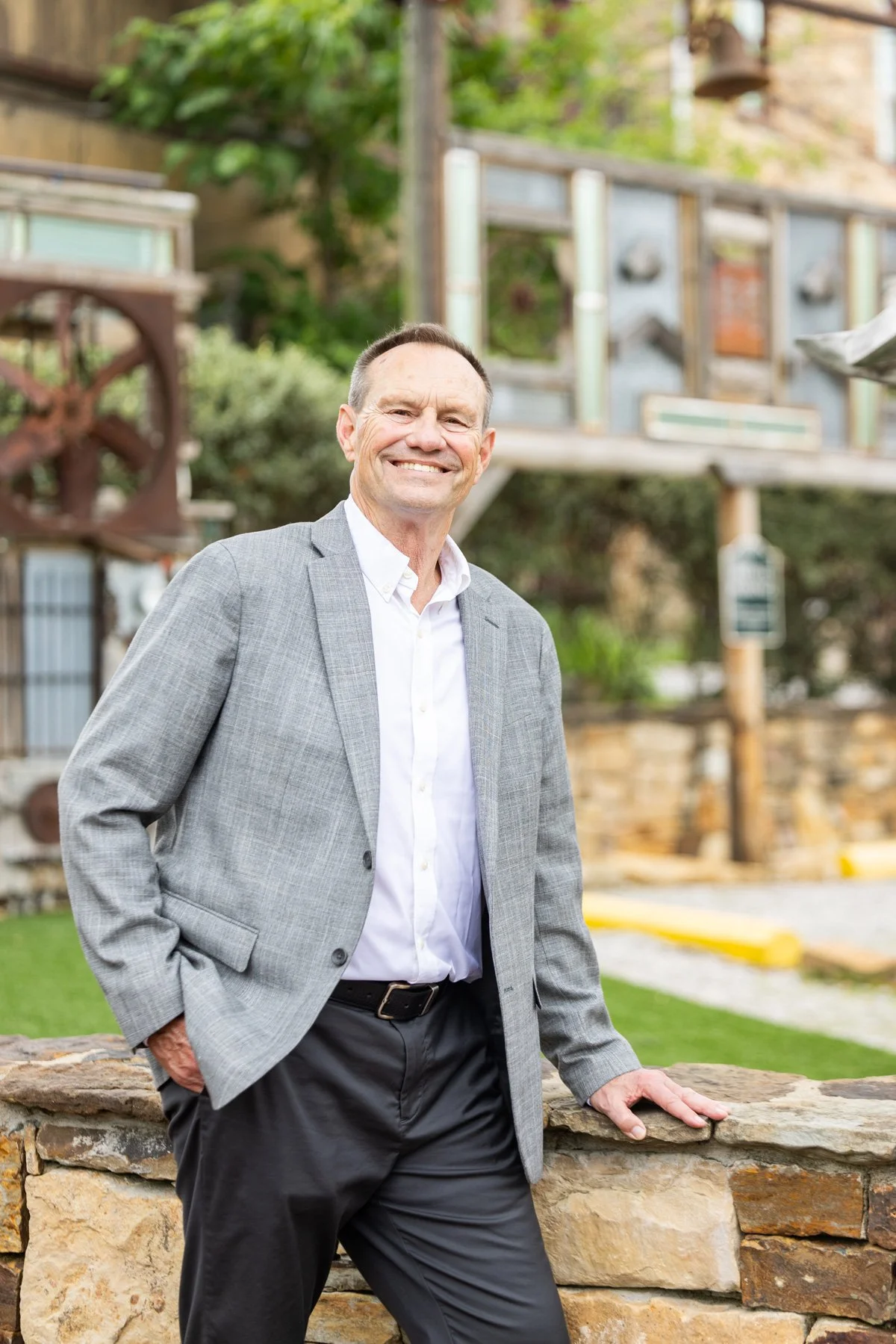
Mayor Rick Elumbaugh, Batesville’s longest-serving mayor, celebrates 18 years of leadership and downtown revitalization. - Photo by NOVO STUDIO
“It’s very complimentary when we have other communities reaching out to us to say, ok, tell us how you did that,” Elumbaugh said.
It’s clear within moments of speaking with Elumbaugh from his office in Batesville that his passion is genuine. Passion might fuel a campaign, but it can’t govern for long, and certainly not for five terms.
Now in his 18th year, Elumbaugh is Batesville’s longest-serving mayor. He’s successfully navigated expensive but critical infrastructure development, sales-tax referendums and a campaign — once controversial — to create Batesville’s downtown historic district, which has proved to be foundational for downtown revitalization.
His passion is contagious and surely the spark in his leadership style, but it’s his pragmatism, listening and prioritization of partnerships that have kept him in office and enabled what many consider his greatest successes, which he is quick to emphasize are “Batesville’s successes.”
This innovative mayor has an unconventional origin story. Before running for office in 2006 he’d already dedicated 30 years to a successful career as an educator teaching physical education and coaching. He ran the municipal pool for 32 summers. He was inspired to pursue a career in education by his sister and his teachers.
Elumbaugh made national news in his previous role as a physical education teacher. Mountain biking had risen in popularity in parts of the U.S., but it was not accessible for many of his students despite the abundance of natural areas.
Elumbaugh was and continues to be an avid mountain biker. He went on a mission to find school mountain biking programs in hopes of learning from them and making use of their curriculum for his students.
“I reached out to [Mountain Bike Magazine] trying to find another program, to find a curriculum but I had to create my own,” he said. But he had piqued their interest. The magazine featured his program in 1996.
“I always wanted to think outside of the box. What can we do for the students? How can we make their lives better?”
The more one learns of his experience as a teacher, the more similarities between his two careers become apparent.
“You’ve got to be that person who listens and gets to know all of your students. And I think that’s the same principle that I’ve always lived by,” he said. “You’ve got to know your citizens.”
But why, after a successful 30-year career, did this educator decide to run for mayor?
“Being an educator, I knew our community … [running for mayor] just seemed to be a perfect fit because I knew the community,” he said. “That’s the number one thing. It’s about engaging your community and engaging your city council.”
When Elumbaugh took office there had not been any significant infrastructure upgrades in decades. He watched other communities make progress while Batesville stagnated.
“I’ve lived here all of my life and I saw the potential of our community. I knew there were challenges,” he acknowledged. “We live in a very, very giving community but we just seemed to be stuck in the ‘80s.”
In a Smart Growth America case study, one hears the former teacher in Elumbaugh as he laments the loss of former students to other communities with appealing amenities like bike trails and a vibrant, walkable downtown. In the same way Elumbaugh once strove for more for his students, he’s been hustling for something extra for his citizens for nearly 20 years. He was thinking about the role of parks and recreation and placemaking in Batesville’s community and economic development before they were the topics du jour they have become in many communities today.
Attracting new citizens and recruiting new employers are worthy goals, but it’s clear that while Elumbaugh is keen on those pursuits, his approach is firmly rooted in making Batesville the best it can be for those who already live and do business there. This guides his community engagement strategy, in collaboration with the Batesville Chamber of Commerce, Main Street Batesville and community partners.
“I think the city council, and I hope myself as well, I hope we’ve built that trust in our community. We want to give our community the best amenities.”
One of Elumbaugh’s successful community engagement tactics is his recurring first Thursday community updates. The county judge now also joins him for these updates, which have become known as the “City County Connection.”
“Your chance of recruiting industry is sometimes like winning a lottery,” Elumbaugh said. “You’ve got to support what you do have here, and I think that is so crucial.”
As evidence for this point, Elumbaugh recounts the cautionary tale of Newport losing Sam Walton to Bentonville due to a landlord’s refusal to renew his lease.
“We cannot let something like a Walmart or Sam Walton get away … we have to always do everything we can to help and make our community one that people want to locate in. We’ve got to work with our colleges, we’ve got to work with our businesses that are here.”
Some of the many accomplishments during his leadership that have contributed to Batesville’s revitalization include sales-tax referendums, a new wastewater treatment plant, new parks and recreation amenities, a community center and the creation of a historic district downtown, which has paved the way for numerous developments.
In the mid-2000s, Batesville’s wastewater treatment plant was in dire need of replacement. “The biggest challenge when I took office was that wastewater treatment plant. For us to continue to retain and recruit industry, we knew that infrastructure was crucial,” he said.
Eventually, the state of Arkansas issued a consent administrative order. It was non-negotiable. Something had to be done. This essential but expensive infrastructure project would require approval of a sales-tax referendum. That initial campaign failed.
It was part of a funding package that citizens felt was too much. “You have to learn from your mistakes,” Elumbaugh said. “Our citizens did not want that. But when we came back, we were successful.”
The sales-tax proposal passed with over 90% approval. Batesville’s new water treatment plant, the first moving bed biofilm reactor in the state, was launched in 2015.
The Great Recession was a difficult time for many communities and Batesville felt the pain in 2008. “We had two plants close that had been here since the 1960s. That was alarming to a new mayor,” he remembered.
Elumbaugh pivots excitedly to what he describes as a Cinderella story and evidence of the importance of supporting the businesses already invested in the community. “Two young men, Phil Pulley and Robert Foster, had started Bad Boy Mowers and they were growing. That was a glimmer of sunshine. Now, they’re one of our top three employers.” The company has grown to employ more than 400 people with 900 dealerships.
“You’ve got to have infrastructure, but you’ve got to have quality of life and quality of place,” he said. “But it takes a complete vision to be a good mayor and I hope I’m that.”
The voice of a veteran physical education teacher comes out as he espouses not only the economic benefits, but also the health and well-being benefits of quality public spaces, a walkable downtown, parks, trails and recreational facilities.
Soon after his election, Elumbaugh met with Main Street Batesville, part of the Department of Arkansas Heritage. This partnership led to the designation of Batesville’s downtown as a historic district. That effort enabled new investment and revitalization efforts.
“Now, our downtown is an economic hub for our community and it’s growing every day,” Elumbaugh said.
When asked what advice he might share with himself 18 years ago or with another newly elected mayor with big plans, he ponders for a moment.
“When I first started, I was really gung ho. I knew the infrastructure was important. But I had to slow down because I wanted to do it all,” he said.
Council members advised early in his tenure that he prioritize critical infrastructure first, which meant postponing some community development projects. He listened to them.
“My advice, listen to your council. I did that.”
He says there isn’t much he would change. “I look back at my first year as a teacher and I was a different teacher in my last 20 years ... You grow with your community. And you listen. You’ve got to listen to your citizens.”
There are multiple new developments underway in downtown Batesville and more planned for the future, including park updates and a downtown plaza.
“This community has embraced change.”